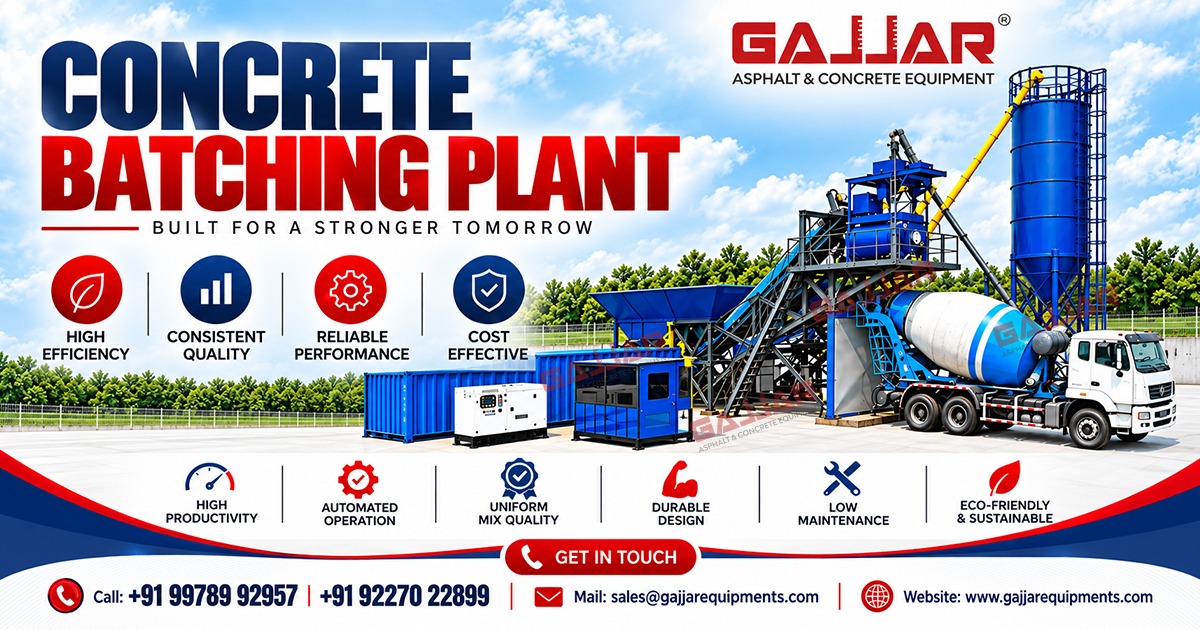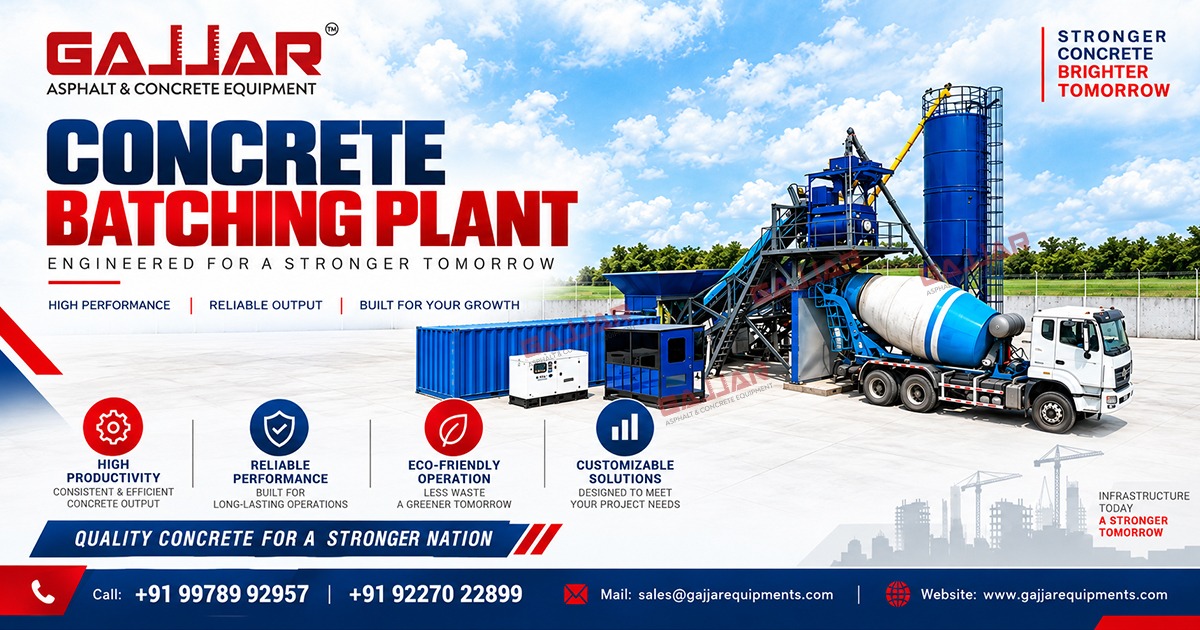
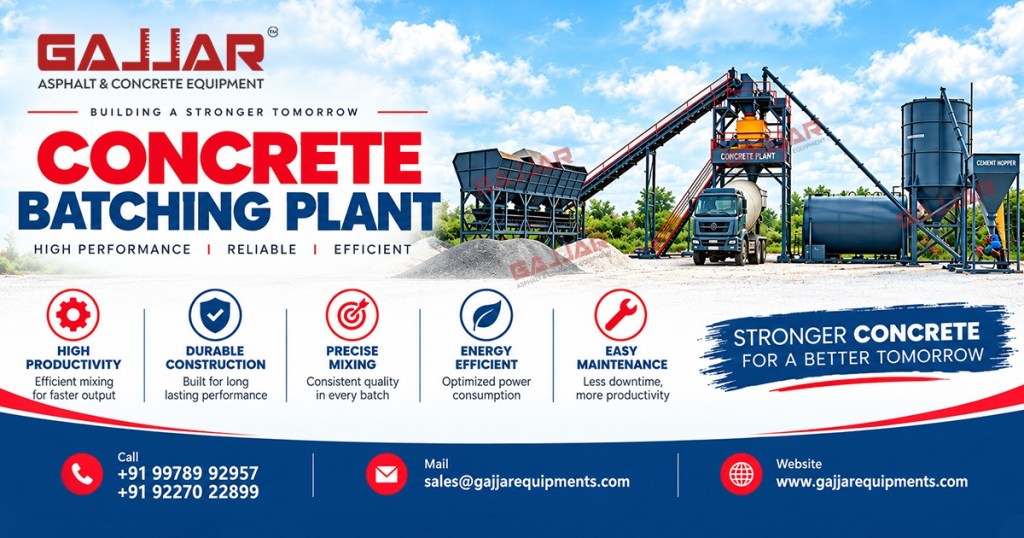
Gajjar Equipments Pvt. Ltd. supplies concrete batching plants to Niger for contractors, infrastructure companies, ready-mix producers, precast manufacturers, and industrial construction projects.
The plants are designed to combine accurate material dosing, controlled mixing, and efficient concrete discharge for consistent production at demanding project sites.
Our manufacturing unit is based in Ahmedabad, Gujarat, India.
How Does a Concrete Batching Plant Work?
A concrete batching plant follows a controlled sequence to convert individual raw materials into uniform concrete.
1. Aggregate Feeding
- Different sizes of sand and aggregates are loaded into individual storage bins.
- Separate compartments help maintain material segregation and controlled feeding.
2. Aggregate Weighing
- Required quantities of aggregates are measured through weighing systems.
- Accurate dosing helps maintain the specified concrete mix ratio.
3. Cement and Powder Dosing
- Cement is stored in silos and transferred through screw conveyors.
- The required quantity is weighed before entering the mixing system.
4. Water and Admixture Measurement
- Water and chemical admixtures are measured according to the selected mix design.
- Controlled dosing supports consistent concrete properties.
5. Material Transfer
- Weighed materials move toward the mixing unit through the plant’s conveyor or skip arrangement.
6. Concrete Mixing
- The mixer combines aggregates, cement, water, and admixtures into a homogeneous concrete mixture.
7. Discharge
- Finished concrete is discharged into transit mixers, concrete pumps, dumpers, or other suitable transportation systems.
8. Continuous Production
- The batching cycle repeats according to the required production rate, helping maintain a steady concrete supply.
Major Components of Concrete Batching Plant
Aggregate Bins
- Store different aggregate sizes separately.
- Support controlled material feeding.
- Help maintain proper aggregate proportions.
Aggregate Weighing System
- Measures sand and aggregates according to the selected recipe.
- Improves batching accuracy.
- Supports repeatable concrete production.
Cement Silo
- Stores cement securely before batching.
- Provides continuous cement availability for production.
- Can be configured according to project storage requirements.
Screw Conveyor
- Transfers cement from the silo to the weighing or mixing section.
- Enables controlled powder movement.
- Supports reliable material feeding.
Water Weighing System
- Measures the required water quantity for every batch.
- Helps maintain the designed water-cement ratio.
Admixture Dosing System
- Adds liquid admixtures in controlled quantities.
- Supports concrete formulations requiring specific performance characteristics.
Concrete Mixer
- Performs the central mixing operation.
- Combines all measured ingredients into a uniform concrete batch.
- Mixer selection can depend on capacity and application.
Control Panel
- Coordinates the batching sequence.
- Allows operators to monitor material dosing and production cycles.
- Helps simplify plant operation and process monitoring.
Conveyor or Skip System
- Transfers aggregates from storage or weighing sections toward the mixer.
- Configuration depends on plant layout and project requirements.
Features of Gajjar Equipments’ Batching Plants
- Accurate aggregate and cement weighing
- Controlled water and admixture dosing
- Efficient concrete mixing
- Modular plant configuration
- Optimized material handling
- Centralized operational control
- Different production capacity options
- Suitable for stationary and project-based applications
- Expandable storage arrangements
- Designed for demanding construction environments
Applications in Niger
Concrete batching plants can support concrete requirements for:
- Highways and road infrastructure
- Bridges and culverts
- Commercial buildings
- Residential developments
- Industrial facilities
- Precast concrete production
- Government infrastructure projects
- Airport construction
- Urban development
- Large-scale civil engineering projects
Frequently Asked Questions
Q1: How does batching improve concrete quality?
A1: Controlled weighing and automated dosing help maintain consistent proportions of raw materials from batch to batch.
Q2: What are the main components of a batching plant?
A2: Major components include aggregate bins, weighing systems, cement silos, screw conveyors, water and admixture systems, mixer, and control panel.
Q3: Can Gajjar Equipments supply batching plants to Niger?
A3: Yes, Gajjar Equipments Pvt. Ltd. supplies concrete batching plant solutions for construction and infrastructure requirements in Niger.
Q4: Which projects require concrete batching plants?
A4: They are commonly used for roads, bridges, buildings, precast production, industrial infrastructure, and large civil construction projects.
Q5: How do I select the right batching plant capacity?
A5: Capacity should be selected according to concrete demand, project duration, operating hours, site conditions, and future production requirements.
Concrete Batching Plant Export Locations in Niger
Gajjar Equipments exports concrete batching plants to Niger, including: Niamey, Maradi, Zinder, Tahoua, Agadez, Arlit, Birnin Konni, Dosso, Kouré, Gaya, Diffa, Kollo, Madaoua, Matamey, Lazaret, Dabaga, Tillabéri, Gouré, Nguigmi, Guidan Roumdji, Baléyara, Galmi, Ayorou, Kawara, Toulou, Gidan Idèr, Takiéta, Dabnou, Bani Bangou, Laba, Bakin Birji I, Tyourout, Nasarawa, Bélbéji, Sabon Birni, Bouti, Koundoumawa, Kouli Kouara, Sabonkafi and many more.
Build Stronger Projects in Niger
Build stronger projects in Niger with Gajjar Equipments’ reliable batching technology engineered for consistent concrete production.
Mobile and WhatsApp: +91 92270 22899
Email: sales@gajjarequipments.com
Website: www.gajjarequipments.com
View Product: Click here